The bottom line on driving here
Curacao drives on the right, the same as the United States and mainland Europe. The island is about 60 km long and one main road runs most of its length, so getting lost takes effort. Most visitors are comfortable within an hour.
The parts that catch people out are Dutch: priority-to-the-right at unmarked junctions, European signage, and a lot of roundabouts. Add unlit rural roads after dark and the occasional goat, and you have the whole list.
Rules of the road
Drive on the right, overtake on the left. Speed limits are posted in kilometers per hour and are typically 45 km/h inside built-up areas and 60 to 80 km/h outside them. Signs are the authority, and limits drop sharply on the approaches to villages.
Road signs follow the Dutch and wider European pattern: red-bordered circles for prohibitions, blue circles for obligations, and a yellow diamond marking a priority road. If you have driven in the Netherlands, none of it will be new.
The rule that surprises North American drivers is priority to the right. At an unmarked junction with no signs and no markings, traffic coming from your right goes first. On a road with the yellow diamond you have priority and side traffic must yield.
Seat belts are mandatory. Handheld phone use while driving is not allowed. Drink-driving limits follow Dutch practice and are stricter than most US states, so treat the answer as zero. Police checks happen, especially at weekends.
Most rental agencies here accept a valid license from your home country. Boric asks international visitors to bring an international driving permit alongside it, and RR Car Rental says it accepts one. Around Curacao states plainly that no permit is needed as long as your license uses the Latin alphabet. Check your own agency before you fly.
Roundabouts and Willemstad traffic
Roundabouts are everywhere, particularly on the ring roads around Willemstad. The rule is the standard European one: slow on approach, give way to traffic already in the circle coming from your left, enter when there is a gap, signal right as you leave.
Multi-lane roundabouts near the city are the tricky ones. Take the outside lane if you are leaving at the first or second exit and the inside lane for anything further round. Watch what local drivers do and copy it.
Willemstad itself gets congested between roughly 7am and 9am and again from 4pm to 6pm on weekdays. The bottlenecks are the harbor crossings and the roads feeding them. Plan an extra fifteen minutes if you are catching a flight in those windows.
The two bridges
Willemstad sits either side of the Sint Anna Bay, with Punda on the east side and Otrobanda on the west. Two bridges connect them and they behave completely differently.
The Queen Juliana Bridge is the high road bridge that carries all vehicle traffic over the harbor entrance. It is the only way to drive between the two halves of the city. It is also worth crossing once in daylight for the view down onto the colored waterfront.
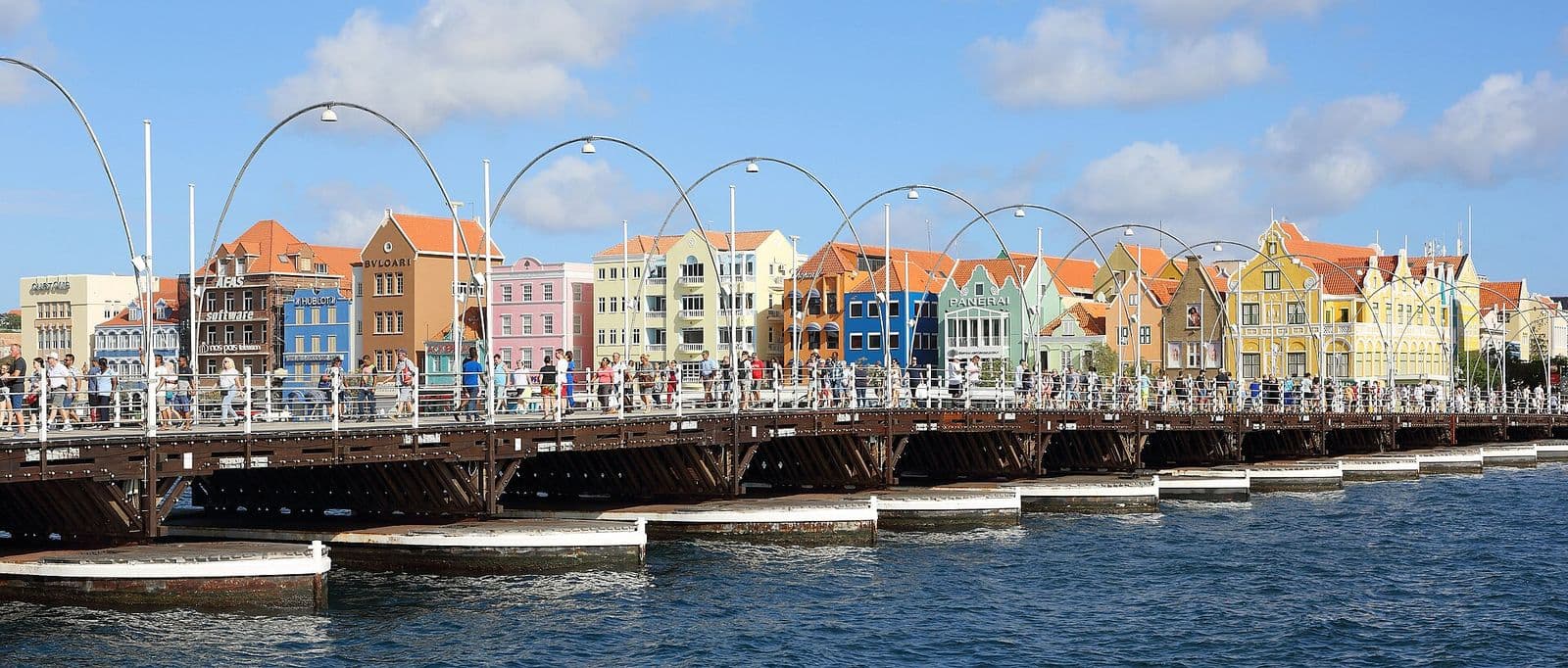
The Queen Emma Bridge is the floating pontoon footbridge at water level. It carries pedestrians only, and it swings open whenever a ship needs to pass. When it opens, free ferries take people across. It does not affect your car, but it does affect how you plan a walk into Punda after parking in Otrobanda.
If you are staying in Punda or Pietermaai and driving to the western beaches, factor the Juliana Bridge into every journey. There is no alternative crossing.
Night driving, animals and road surfaces
Street lighting thins out fast once you leave Willemstad and the resort areas. The roads towards Westpunt, Shete Boka and the northern coast are often completely unlit. Dip your headlights for oncoming traffic, keep your speed down, and give yourself more distance than you would at home.
Goats, donkeys and stray dogs are a genuine hazard on the rural west and north of the island. Goats in particular graze on the verges and step into the road without warning. They are hardest to see at dusk and after dark, which is another reason to be back before nightfall on your first few days.
Main roads are generally in decent condition. Secondary roads, beach access tracks and the streets in older neighborhoods can have deep potholes, and the edges of narrow roads sometimes drop away. Slow down where the surface changes rather than trying to steer round holes at speed.
A few beach access roads are unpaved. Playa Kenepa, Playa Lagun and several of the smaller west-coast bays are reachable in a normal car if you take the last stretch slowly, but check with your agency whether their insurance covers unpaved roads before you commit.
Parking
Parking is free almost everywhere outside the city center. Beach car parks, shopping centers and restaurants outside Willemstad do not charge, and there are usually spaces.
Punda and Otrobanda are the exception. Both have paid parking areas and multi-story car parks, and on-street space in Punda is tight during business hours and on cruise ship days. The easiest approach is to use one of the paid car parks near the waterfront rather than circling the narrow streets.
Cruise ship days are worth checking. When two or three ships are in, the streets around Punda and the Rif area fill up and the walk from a free space gets long. Arriving before 10am or after 4pm makes a noticeable difference.
Fuel and navigation
Fuel stations are attended. An attendant fills the tank for you, and you pay at the pump or in the kiosk. Cash and cards are both normally accepted, though the smaller rural stations are more reliable with cash.
Prices are displayed in Caribbean guilders per liter. The guilder is pegged to the US dollar at roughly 1.79 to 1, so dividing the posted price by 1.79 gives you the dollar figure. Many businesses take dollars as well, but the pump price is quoted in local currency.
Stations cluster around Willemstad and along the main roads. There is very little once you pass Westpunt or head into the national park, so fill up before a day on the north or west coast.
Google Maps covers the island well, including the smaller beach roads. Download the offline map before you land in case your data does not connect immediately. Almost every rental agency here answers WhatsApp, which is the fastest way to reach them if something goes wrong on the road.
Compare rental cars from local Curacao agencies and get on the road.
Compare car rentals now →